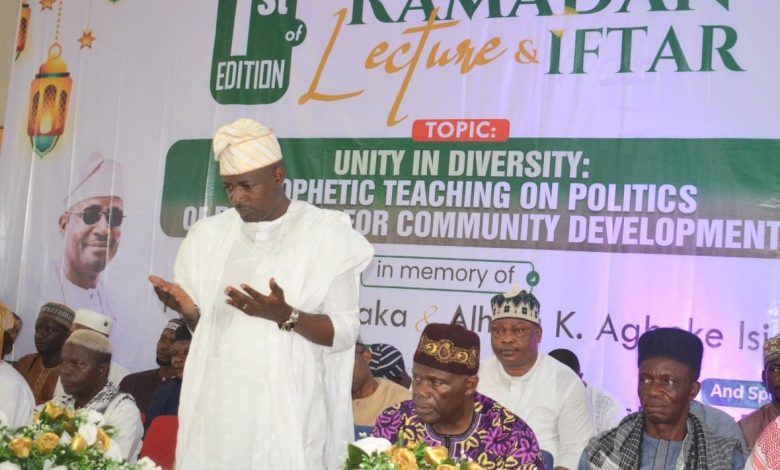

In honour of his late parents while also creating a lasting memory among Muslim Umah, the Ogun State Commissioner for Sports Development, Hon. Wasiu Isiaka last week organized a special prayer for the late Prince Tijani Ade Isiaka and Alhaja Kuburat Isiaka and the iftar Ramadan lecture.
A special prayer was also offered for the Ogun State Governor, Prince Dapo Abiodun for a successful tenure in office.
In his welcome address, Isiaka said the memorial lecture became timely and necessary in the current socio-political climate.

Isiaka said the essence of the Ramadan lecture was to honour his late parents and pray for a successful administration of Governor Dapo Abiodun.

He posited that integrating spiritual values into governance could help address some of the persistent challenges facing local communities.
In his sermon, a muslim cleric, Alhaji Shuaeb Adegbite (Ajibe-Oluwa) has called on the political office holders to consider the
Alhaji Shuaibu Adegbite, a respected Islamic scholar and community leader, has called for a renewed focus on prophetic teachings as a guide for political engagement aimed at fostering peace and sustainable development.
Speaking at a well-attended iftar Ramadan lecture in remembrance of Prince Tijani Ade Isiaka and Alhaja Kuburat Isiaka, parents of the Ogun State Commissioner for Sports, Hon. Wasiu Isiaka, Adegbite emphasised that politics, when rooted in moral and spiritual values, can become a powerful tool for positive transformation within communities.
He explained that prophetic teachings, particularly those derived from the traditions of Prophet Muhammad (peace be upon him), promote justice, accountability, and compassion—qualities that are often lacking in modern political systems.
According to Adegbite, leaders who embody these principles are more likely to prioritise the people over personal or partisan interests.
The cleric highlighted that community development cannot thrive in an environment where corruption, division, and selfishness dominate political discourse.
He urged politicians and aspiring leaders to adopt ethical frameworks grounded in faith, noting that such an approach would help rebuild trust between citizens and their representatives.
Adegbite further stressed the importance of inclusivity in governance, stating that prophetic teachings encourage leaders to listen to all segments of society, including the marginalized.
He said that meaningful development occurs when policies reflect the needs and aspirations of the entire community rather than a select few.
Addressing the youth, Adegbite encouraged them to actively participate in politics but to do so with integrity and a clear sense of purpose.
He warned against being manipulated by divisive rhetoric or short-term incentives, urging young people instead to become agents of positive change guided by moral principles.
He pointed out that political tensions, if left unchecked, can hinder development, whereas dialogue and mutual respect can create an enabling environment for progress.
In addition, Adegbite called on religious institutions to play a more active role in shaping political consciousness. He argued that mosques, churches, and other faith-based organizations have the ability to educate their members on ethical leadership and civic responsibility.
He also urged government institutions to collaborate with religious and traditional leaders in promoting values-based governance.
Such partnerships, he said, could enhance community trust and ensure that development initiatives are both inclusive and sustainable.