


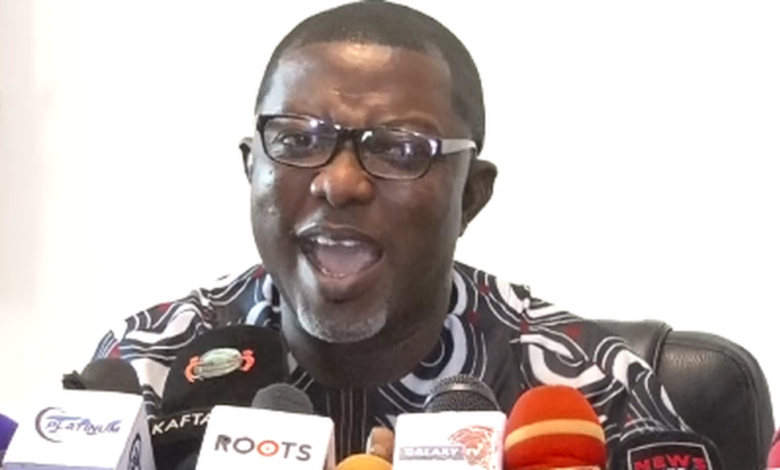

The convener of Sustainability of Governor Dapo Abiodun Legacy and Ogun State Beyond 2027, Mr. Abayomi Arabambi, has dismissed a sponsored newspaper article by the Ogun Good Governance Forum (OGGF) questioning the implementation of 1,377 federal projects reportedly valued at ₦783 billion in Ogun State between 2024 and 2026.
The article, titled “Ogun Bleeds: 1,377 Projects, ₦783bn in 3 Years, Where Are These Projects?”, alleged that only a fraction of the projects could be verified on the ground and raised questions about the allocation and implementation of the projects across 48 federal Ministries, Departments and Agencies (MDAs).
But Arabambi, in a strongly worded rebuttal, described OGGF as an “unknown forum with a known agenda,” accusing the group of presenting figures without adequate context and drawing conclusions without conducting sufficient field investigations.

According to him, the credibility of any organisation claiming to champion good governance should be established through transparency, verifiable research and sustained engagement with relevant authorities and communities.

Arabambi questioned the identity, membership, funding and previous activities of the group.
He argued that the allegation that fewer than 100 of the 1,377 projects could be verified required substantial fieldwork and documentary evidence before such a conclusion could responsibly be reached.
Arabambi also faulted the forum’s interpretation of some project allocations which, according to OGGF, appeared to have been assigned to agencies whose traditional mandates did not directly correspond with the projects.
He explained that the federal budgeting and project implementation process could involve multi-agency arrangements, legislative interventions and the designation of implementing agencies based on their capacity, track record and ability to deliver projects effectively.
He cited the example of power, road and other infrastructure projects being domiciled in agencies whose primary mandates may appear unrelated, stressing that such arrangements should not automatically be interpreted as evidence of impropriety.
He added that such projects could be facilitated by legislators and other stakeholders based on calculations about effective and timely implementation.
Arabambi maintained that an implementing agency could engage competent contractors to execute projects outside its immediate core mandate, arguing that the ultimate consideration should be whether the project is properly funded, executed and delivered to the intended beneficiaries.
He further rejected the suggestion that the increase in federal project allocations to Ogun State constituted evidence that public resources were being deployed as an electoral tool ahead of the 2027 elections.
Describing such a conclusion as political rather than evidence-based, Arabambi said the approaching election season should not be used as a basis for making unsubstantiated allegations against public officials or political actors.
He accused OGGF of attempting to create distrust around the administration of Governor Dapo Abiodun and the political aspiration of the APC governorship candidate, Senator Adeola Olamilekan Adeola, popularly known as Yayi.
Arabambi said the forum’s approach was inconsistent with the principles of genuine civil society advocacy, arguing that a credible governance organisation should engage the government, request relevant documents, visit project locations and allow authorities an opportunity to respond before publishing sweeping allegations.
He, however, agreed with OGGF report on the establishment of a mechanism involving traditional rulers, civil society organisations and technical experts to track federal projects across the state.
He said such a mechanism would be useful for independently monitoring federal projects, while arguing that organisations raising questions about public expenditure should equally demonstrate the work they had done to substantiate their claims.
“They have presented figures without context, drawn conclusions without investigation, and made allegations without evidence. That can be best put as irresponsibility packaged as civic engagement.
“And when the media amplifies such material without demanding proof, they betray the public trust they are meant to serve.
“This is not about defending anyone. It is about defending a standard—and that standard is under attack. OGGF has not earned the right to be taken seriously. They have hidden their identities and concealed their existence in real life. That is the behaviour of people with something to hide.
“Now, let us examine their claims. They claimed that between 2024 and 2026, the federal government appropriated ₦783 billion for 1,377 projects in Ogun State across 48 MDAs.
“They also alleged that fewer than 100 of these projects can be verified on the ground. That is a very serious allegation. It is also a very easy allegation to make when you have done absolutely no fieldwork. Did OGGF visit any of these sites? Did they speak to community leaders in Ogun West, Ogun East, or Ogun Central? Did they request project documents from any of the 48 MDAs they mentioned? The answer is almost certainly no. They sat in a room somewhere, probably in Lagos or Abuja, looked at budget figures, and decided to manufacture a scandal.”
On Nigeria’s rising debt profile, Arabambi agreed that the country’s debt burden remained a serious concern and that public funds must be properly accounted for.
He, however, cautioned against equating inability to independently locate or verify a project with proof that the project was nonexistent, abandoned or misappropriated.
Arabambi said public discourse on governance should be driven by evidence rather than sensationalism, stressing that genuine accountability requires facts, documentation and verifiable investigations.
He also accused the OGGF report of reducing a complex federal budgeting and project implementation process into a sensational political narrative.
According to him, Nigerians deserve “honest debate, genuine accountability and real advocacy,” rather than anonymous or poorly established organisations making serious allegations without providing sufficient evidence.


