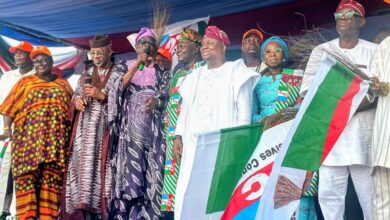
Awujale Stool: Kuye’s National, International Networks Could Boost Ijebuland Development


Awujale Stool: Kuye’s National, International Networks Could Boost Ijebuland Development
By Akin Alade
As the succession process for the revered Awujale and Paramount Ruler of Ijebuland continues to attract intense attention, the profile of Prince Ademorin Aliu Kuye is increasingly becoming difficult to ignore.

Beyond questions of royal lineage and traditional eligibility, Kuye stands out for a combination of political experience, public-service exposure, national relationships and wider networks that could prove valuable to Ijebuland in an era when traditional rulers are increasingly expected to serve not only as custodians of culture, but also as development advocates, bridge-builders and influential voices for their people.

For supporters and observers of the succession process, Kuye’s intimidating profile raises an important question: Could his extensive national and international connections become the kind of advantage Ijebuland needs in its next Awujale?
The answer ultimately rests with the legitimate traditional process, but the relevance of such experience cannot easily be dismissed.
Kuye’s Profile Goes Beyond Traditional Ambition
The Awujale stool is one of the most respected traditional institutions in Nigeria.
Whoever eventually occupies it will inherit responsibilities far beyond palace ceremonies.
The next Awujale will be expected to interact with governments, business leaders, investors, development institutions, traditional rulers, professionals, diplomats, Nigerians in the diaspora and influential stakeholders across the country and beyond.
This is where Kuye’s background appears particularly significant.
His reported experience across different layers of public life has exposed him to government administration, political structures and decision-making processes.
Over the years, he has reportedly built relationships within Lagos, Ogun State, Abuja and wider national political circles.
In contemporary traditional leadership, such networks could become powerful development tools.
National Connections Could Open Doors for Ijebuland
One of the strongest advantages associated with Kuye’s profile is his access to national networks.
Traditional rulers today increasingly play important roles in attracting government attention to the developmental needs of their communities.
A monarch who understands how government operates and possesses relationships across the corridors of power may be better positioned to advocate effectively for his people.
Such connections could become useful in areas including federal infrastructure, educational development, healthcare, agriculture, tourism, employment generation, youth empowerment and investment attraction.
Ijebuland has enormous economic, cultural and tourism potential.
A monarch with strong relationships at federal and state levels could potentially leverage those contacts to ensure that the region receives greater attention in national development conversations.
That is why Kuye’s political exposure should not necessarily be viewed only through a partisan lens.
Properly deployed, political experience can become development capital.
International Exposure Matters in Modern Traditional Leadership
Beyond national influence, international connections are becoming increasingly important for traditional rulers.
The modern monarch must be able to relate with the diaspora, investors, international development organisations, multinational companies and influential Nigerians living abroad.
Ijebu sons and daughters are scattered across Europe, North America, Africa and other parts of the world.
A forward-looking Awujale should be capable of bringing these people together, strengthening their connection with their homeland and encouraging them to invest in Ijebuland.
Kuye’s broader networks could therefore become useful in building stronger relationships between Ijebuland and the international community.
Such connections could assist in attracting foreign investment, promoting Ijebu tourism, supporting educational partnerships and creating opportunities for young people.
A traditional ruler with access beyond Nigeria’s borders may also be able to promote Ijebu culture internationally and position the ancient kingdom as a destination for heritage tourism and investment.
Political Experience Can Be an Advantage
Political experience is sometimes treated with suspicion in traditional succession debates.
However, political exposure does not automatically make a monarch partisan.
What matters is how such experience is used after assuming the throne.
A politically experienced traditional ruler can understand government without becoming controlled by government.
He can relate with political leaders without turning the palace into a political platform.
He can lobby for development without compromising the neutrality of the traditional institution.
Indeed, understanding government structures could enable a monarch to negotiate more effectively for the interests of his people.
If Kuye were eventually to emerge through the legitimate traditional process, one of the major tests would therefore be his ability to transform years of political networking into practical development opportunities for Ijebuland.
Lagos Networks Could Become Economic Advantage
Kuye’s longstanding exposure to the Lagos political and administrative environment could also become significant.
Lagos remains Nigeria’s commercial nerve centre and home to some of the country’s biggest businesses, investors, professionals and financial institutions.
Having deep relationships within such an environment could potentially give an Awujale greater access to influential private-sector leaders.
Ijebuland sits strategically close to Lagos and possesses enormous opportunities in property development, agriculture, tourism, manufacturing, education and commerce.
An Awujale capable of connecting investors with opportunities across Ijebu communities could accelerate economic development.
The palace can become a powerful platform for promoting investment when led by a monarch who understands both tradition and the modern economy.
Kuye Could Serve as Bridge Between Palace and Government
Traditional rulers occupy an important middle ground between government and the grassroots.
They understand community needs while also possessing the institutional standing to engage leaders at the highest levels.
Kuye’s public-service experience could potentially make him comfortable operating in both environments.
He could understand the concerns of ordinary people while knowing how to present those concerns effectively before government institutions.
Such an ability could become particularly valuable when communities need intervention on roads, security, electricity, healthcare, schools and economic projects.
The next Awujale will need more than ceremonial influence.
He will need the capacity to advocate.
He will need relationships.
He will need credibility.
And he will need the confidence to approach decision-makers on behalf of Ijebuland.
A Monarch for a Changing Generation
Ijebuland is changing.
Its young population increasingly expects opportunities, digital inclusion, employment, entrepreneurship support and stronger connections with the global economy.
The next Awujale will therefore need to understand both the traditions of the past and the realities of the future.
A monarch with broad political, professional and international exposure could potentially connect these two worlds.
He could preserve the cultural values of Ijebuland while encouraging innovation and investment.
He could promote traditional institutions while also engaging technology entrepreneurs, business leaders and younger professionals.
This combination of tradition and modern exposure is becoming increasingly important for successful traditional leadership.
Development Must Be the Ultimate Test
Despite the attractions of Kuye’s networks, connections alone should never determine succession to the Awujale stool.
Traditional legitimacy must remain the foundation.
His Fusengbuwa credentials, like those of every other aspirant, should be established through recognised family structures, relevant records, established customs and applicable laws.
No political relationship should replace traditional eligibility.
However, once legitimate qualification is established, broader experience becomes relevant when examining what an aspirant could contribute to the future of Ijebuland.
The central question should therefore be whether Kuye can turn influence into impact.
Can his national relationships attract infrastructure?
Can his international connections encourage investment?
Can his Lagos networks support economic development?
Can his public-service experience strengthen advocacy for Ijebu communities?
Can he unite traditional authority with modern development thinking?
Those are legitimate questions in evaluating the profile of a potential monarch.
The Awujale Throne Needs Influence With Purpose
The late Awujale, Oba Sikiru Kayode Adetona, built a powerful institution whose influence extended far beyond the palace.
His successor will inherit the responsibility of preserving that dignity while taking Ijebuland into another era.
The next Awujale will require courage, wisdom, independence and traditional legitimacy.
But he may also need strong relationships.
Influence matters when it is deployed for development.
Connections matter when they create opportunities for the people.
National access matters when it helps communities secure projects.
International relationships matter when they attract investment and strengthen the global profile of Ijebuland.
This is why Kuye’s intimidating profile and extensive networks are attracting attention.
Could Kuye Become Ijebuland’s Development Monarch?
The growing discussion around Prince Ademorin Aliu Kuye should therefore extend beyond political labels.
His experience and relationships could potentially provide Ijebuland with a monarch capable of navigating both the traditional institution and the modern corridors of influence.
If legitimately selected, such connections could become a powerful instrument for accelerating development across Ijebuland.
But there must be balance.
Political relationships should serve the palace, not control it.
International connections should benefit the people, not merely enhance personal prestige.
Networks must be converted into schools, roads, investments, jobs, tourism opportunities, youth programmes and stronger institutions.
That should be the real measure of their value.
Ultimately, the emergence of the next Awujale must remain the responsibility of the legitimate traditional process.
But as Ijebuland considers the qualities required of the monarch who will lead it into a new era, the capacity to build bridges beyond the kingdom cannot be ignored.
Kuye’s profile may therefore represent more than political strength.
It could represent development leverage.
His national connections could become advocacy power.
His international relationships could open investment doors.
His public-service experience could strengthen engagement with government.
And his political networks, if responsibly deployed, could become an important asset in the continuing development of Ijebuland.
For a throne expected to remain culturally rooted while becoming increasingly development-driven, that combination may prove difficult to overlook.