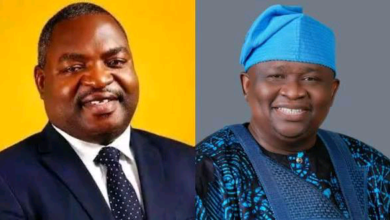
 Atiku’s Subsidy Promise Is Political Strategy, Fayemi Says
ABUJA — Former Ekiti State Governor, Kayode Fayemi, has described former Vice President Atiku Abubakar’s promise to restore fuel subsidy if elected president in 2027 as a political strategy aimed at capitalising on the hardship caused by subsidy removal.
Fayemi made the comment while speaking on Arise Television’s Prime Time, where he discussed the ongoing political debate over fuel subsidy and Atiku’s position ahead of the 2027 presidential election.

According to Fayemi, Atiku’s subsidy proposal is politically comparable to the All Progressives Congress’ decision to run a Muslim-Muslim presidential ticket in the 2023 election.


“My take on that is that Atiku’s proposal of subsidy is politically equivalent to our own Muslim-Muslim ticket in 2023. It’s a political strategy. It’s not an economic construct,” Fayemi said.
He, however, acknowledged that the promise could appeal to Nigerians struggling with the effects of the removal of petrol subsidy.
Fayemi said many vulnerable Nigerians were more concerned about the rising cost of living and their ability to meet basic needs than the technical arguments surrounding subsidy policy.
He said Atiku was taking advantage of the hardship experienced by this segment of the population in making the promise.
“I believe that’s what Vice President Atiku is taking advantage of. The vulnerable segment of the population is still hard done by,” Fayemi said.
Fayemi defends subsidy removal
Despite his criticism of Atiku’s proposal, Fayemi maintained that he remains an advocate of fuel subsidy removal.
The former governor said he had pushed for the policy for years, including during his tenure as chairman of the Nigerian Governors’ Forum.
“I was and I remain an advocate of fuel subsidy removal. As chairman of the governors’ forum, I spent four years in this battle,” he said.
Fayemi also said President Bola Tinubu inherited substantial work on subsidy removal from the previous administration, although he faulted the manner in which the policy was implemented.
“What President Tinubu inherited, in fairness to him, was the work that had already been completed by that administration. The only challenge I had with it was the way it was done,” he said.
Governors had planned safety net, Fayemi says
Fayemi disclosed that the Nigerian Governors’ Forum had previously worked with the Federal Government and the World Bank on a safety-net strategy intended to protect vulnerable Nigerians from the effects of subsidy removal.
He said the measures were designed to cushion the impact of the policy on poorer Nigerians.
However, he argued that the continuing hardship experienced by many citizens had created an opportunity for Atiku to make the restoration of subsidy an attractive political proposition.
Fayemi said Nigerians affected by the economic difficulties were primarily concerned about being able to afford food, pay school fees and deal with unexpected expenses.
He further linked poverty and inequality to insecurity, arguing that economic hardship contributes to problems such as insurgency and banditry.
2027 politics
Atiku, the presidential candidate of the African Democratic Congress (ADC), has made the restoration of fuel subsidy a major part of his economic message ahead of the 2027 presidential election.
Fayemi’s comments add another dimension to the growing political debate over whether subsidy should be restored or permanently replaced with alternative measures to reduce the burden of high fuel prices.
While Fayemi insists that subsidy removal remains economically necessary, he acknowledged that the policy has placed significant pressure on vulnerable Nigerians.
With the 2027 election approaching, the disagreement over fuel subsidy is likely to remain a major campaign issue as political parties and presidential contenders seek to convince voters of their preferred approach to Nigeria’s economy.