



Ondo Air Crash: Questions Mount as Tinubu Orders Probe Into NAF Aircraft Tragedy
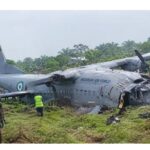
The Ondo air crash investigation has assumed a new dimension as President Bola Ahmed Tinubu directed the Nigerian Air Force to establish the circumstances surrounding the crash of an ATR-42 military aircraft in Igbokoda, Ondo State, with the outcome expected to provide answers on what went wrong and how similar tragedies can be prevented.

The aircraft, identified as Nigerian Air Force NAF 931, was on a routine mission between Benin and Lagos when it crashed near a naval base in the Igbokoda area on Monday. Authorities said 25 passengers and seven crew members were on board.


Rather than allowing speculation to dominate public discussion, the presidential directive places the focus squarely on a comprehensive examination of the circumstances preceding the crash. Tinubu said the Chief of the Air Staff had briefed him before he ordered the Air Force to immediately commence a thorough investigation into the cause of the accident.
The development comes as questions are expected to emerge over the aircraft’s operational history, maintenance, flight conditions and the events surrounding the loss of contact with air traffic controllers. The aircraft reportedly disappeared from radar at about 9:13 a.m. before its wreckage was located close to the naval base.
For aviation and military safety experts, the investigation will be important not only for establishing responsibility but also for identifying possible weaknesses that could be addressed across the Nigerian Air Force fleet. A credible technical investigation could help determine whether the incident resulted from mechanical failure, operational circumstances, environmental factors or a combination of issues.
The Nigerian Safety Investigation Bureau has also clarified its position, saying the accident involves a military aircraft and therefore falls outside its statutory mandate for direct investigation. However, the bureau said it could provide technical assistance to the military if formally invited.
Such assistance could prove significant if investigators require specialised analysis of flight data or cockpit voice recordings. The NSIB said it could deploy investigators and make its Flight Safety Laboratory available if requested by the Nigerian Air Force.
The tragedy has consequently placed renewed attention on the importance of rigorous maintenance, flight-safety procedures and transparent accident investigation within military aviation. The ATR-42 involved in the incident was one of the Nigerian Air Force’s aircraft used for intelligence, surveillance, reconnaissance and other operational duties.
Tinubu commended the Nigerian Air Force for activating search-and-rescue operations as well as first responders and the Ondo State Government for their response at the crash site. He also expressed condolences to the families of those on board and described the incident as a painful moment for the Armed Forces and the country.
For the families affected, however, the investigation will carry significance beyond official statements. Establishing exactly what happened could provide important answers while ensuring that lessons from the tragedy are translated into concrete improvements in military aviation safety.
The focus now shifts to the investigators as they examine available evidence and reconstruct the aircraft’s final moments. Until the investigation is completed, authorities and the public will need to avoid unverified claims about the cause of the crash.
The Ondo air crash therefore presents the Nigerian Air Force and the Federal Government with a critical responsibility: to establish the facts, communicate credible findings and ensure that any safety gaps identified from the tragedy are promptly addressed.


