

FG Begins Seven-Week Process for National Policing Bill, Invites Nigerians to Shape State Police Framework


FG Begins Seven-Week Process for National Policing Bill, Invites Nigerians to Shape State Police Framework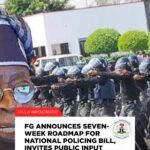
The Federal Government has launched a seven-week roadmap for the development of the proposed National Policing Bill, inviting Nigerians and key stakeholders to submit memoranda and policy recommendations that will shape the legal and operational framework for the establishment of state police across the country.

The announcement was made on Monday by the Chief of Staff to the President and Chairman of the Presidential Working Group on the National Policing Bill, Femi Gbajabiamila, following the committee’s meeting at the Presidential Villa in Abuja.

According to Gbajabiamila, the Working Group is reviewing the Police Act 2020, the Police Service Commission framework, existing police regulations and other relevant laws to develop a modern, effective and accountable policing system that reflects Nigeria’s security needs.
He explained that the proposed legislation would establish national minimum standards for policing, define state readiness requirements, outline certification procedures, clarify jurisdictional responsibilities, strengthen independent oversight, protect human rights and provide sustainable funding mechanisms. The bill will also set out a structured transition plan for the proposed dual-policing system involving both federal and state police services.
Gbajabiamila disclosed that the public consultation process would remain open for two weeks, allowing citizens, security experts, civil society organisations, professional bodies, academics, security agencies, state and local governments, and other stakeholders to make submissions. The contributions will be reviewed and incorporated into the draft legislation before wider national consultations and eventual transmission to the National Assembly.
The Presidential Working Group has adopted a seven-week implementation timetable running from July 27 to September 14, 2026. Under the schedule, the draft Executive Bill is expected to be presented to President Bola Ahmed Tinubu on September 3 before undergoing further consultations ahead of final approval.
He stressed that no state would be allowed to establish its own police service without meeting clearly defined requirements covering recruitment, personnel vetting, training, salaries and pensions, operational equipment, detention facilities, disciplinary procedures, complaint management, data systems, firearms control, independent oversight and long-term financial sustainability.
Governor Dapo Abiodun of Ogun State, representing the Nigeria Governors’ Forum, described the proposed state police initiative as one of the landmark reforms of the Tinubu administration. He dismissed concerns that the Federal Government intended to control state police, explaining that the proposed legislation is designed only to provide a uniform operational framework while preserving the autonomy of state police services.
Attorney-General of the Federation and Minister of Justice, Prince Lateef Fagbemi, also assured Nigerians that the proposed National Policing Bill would strengthen the protection of lives and property while preventing state police from being used as an instrument of political persecution. He added that states unable to meet the required standards immediately would continue to rely on the Nigeria Police Force until they become fully prepared to establish their own police services.
Also present at the meeting were the Inspector-General of Police, Tunji Disu; President of the Nigerian Bar Association, Afam Osigwe; Chairman of the Policy Advisory Committee, Justice Abdullahi Liman (rtd); Professor Olu Ogunsakin, Head of the Nigeria Police Reform Secretariat; Senior Special Assistant to the President on Planning and Research, Nnadubem Moghalu; and Brigadier General Olutayo Muyiwa Adesuyi, representing the National Security Adviser.


