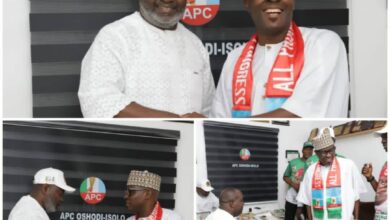
Tinubu 2027 Campaign Faces Test as APC Governors, Wike Battle Over Political Structure


Tinubu 2027 Campaign Faces Test as APC Governors, Wike Battle Over Political Structure
President Bola Tinubu’s 2027 political machinery is facing an emerging internal test as governors elected on the platform of the All Progressives Congress (APC) push back against the cross-party Rainbow Coalition associated with Federal Capital Territory Minister Nyesom Wike.


What initially appeared to be differences over campaign strategy has developed into a wider argument over party structures, candidates and the boundaries of cross-party cooperation ahead of the 2027 general election.
At the centre of the disagreement are two political forces that publicly share one objective — supporting Tinubu’s re-election — but differ sharply over how that objective should be pursued.
The Progressive Governors Forum (PGF), chaired by Imo State Governor Hope Uzodimma, has declared that APC governors will campaign exclusively for candidates sponsored by their party.
The governors reached the position at a closed-door meeting in Abuja, warning against political arrangements that could create divided loyalty, weaken APC candidates or establish competing campaign structures.
Uzodimma said the governors would not participate in or endorse arrangements capable of undermining Tinubu’s re-election, weakening the APC or adversely affecting the party’s candidates.
The position effectively draws a line between the APC’s established campaign machinery and Wike’s Rainbow Coalition, which seeks to bring politicians from different political parties together in support of Tinubu.
Wike, however, has rejected suggestions that his political activities are designed to undermine the ruling party.
The FCT minister maintains that he never approached the APC Governors Forum seeking approval for the coalition and insists that his political mobilisation is primarily directed towards securing Tinubu’s re-election.
He has also said President Tinubu is aware of his political activities, while stressing that he is not accountable to APC governors.
That disagreement has shifted attention to a potentially significant question ahead of the 2027 election: how far can cross-party support for a presidential candidate operate without conflicting with the interests of the candidate’s political party at governorship and legislative levels?
For APC governors, the concern extends beyond the presidential contest.
Governors remain central to party organisation at state and grassroots levels, while governorship, National Assembly and state legislative candidates will also depend heavily on the same political structures being mobilised for the presidential election.
A coalition encouraging voters to support Tinubu for president while backing candidates of another political party for other positions could therefore create competing interests within states.
The governors have consequently insisted that their campaign structures will support APC candidates from the presidential contest down the ballot.
Wike’s approach presents a different political calculation.
Rather than requiring politicians supporting Tinubu to defect formally to the APC, his Rainbow Coalition seeks to accommodate political actors who may remain in their existing parties while backing the President’s re-election.
The strategy potentially provides Tinubu with access to politicians and political structures outside the APC.
But it has also generated resistance from APC stakeholders concerned that strengthening politicians in rival parties could come at the expense of APC candidates competing against them.
The tension has already moved beyond private disagreements.
Wike has publicly criticised some APC governors and rejected their objections to his political strategy, while the governors have formalised their position through the Progressive Governors Forum.
The development leaves the President at the centre of two overlapping political interests.
On one side are APC governors who control influential state party structures and are insisting that Tinubu’s campaign should strengthen the ruling party and all its candidates.
On the other is Wike, a prominent member of the Peoples Democratic Party who has remained a political ally of the President and is attempting to build support for Tinubu beyond conventional APC boundaries.
Wike’s political relationship with Tinubu predates the current disagreement.
During the 2023 presidential election, Wike was part of the PDP G5 governors who refused to support their party’s presidential candidate, Atiku Abubakar, following an internal disagreement over the leadership structure of the PDP.
Tinubu subsequently appointed Wike Minister of the Federal Capital Territory after assuming office.
The current disagreement is therefore significant because it involves political actors who have separately played important roles within the President’s governing and political coalition.
It also highlights the complexities that can accompany cross-party alliances during simultaneous elections.
While a politician from another party may campaign for Tinubu at presidential level, that same politician could be contesting against an APC candidate for another position.
That possibility is at the heart of the governors’ objections to parallel campaign arrangements.
Recent developments suggest the disagreement is already affecting political alignments in several states.
Reports indicate that some aggrieved APC politicians have moved towards the Wike-aligned PDP structure after disagreements arising from party nomination processes, while continuing to express support for Tinubu’s presidential ambition.
This creates an unusual political scenario in which politicians could campaign for an APC presidential candidate while simultaneously working against APC candidates in state or legislative elections.
As campaigning intensifies, the dispute is likely to place greater attention on how the President manages relationships between his party establishment and political allies outside the APC.
For the APC governors, protecting the party’s candidates and established state structures remains central to their position.
For Wike, expanding Tinubu’s support beyond party boundaries remains the stated justification for the Rainbow Coalition.
The unresolved question is whether those two strategies can operate simultaneously without creating competing campaign structures.
How that tension is managed could become an important feature of the political manoeuvring surrounding Tinubu’s 2027 campaign.