

Democracy Has No Alternative in Poverty, Says Adams Oshiomhole as He Highlights Nigeria’s Democratic Progress


Demo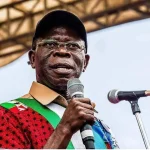 cracy Has No Alternative in Poverty, Says Adams Oshiomhole as He Highlights Nigeria’s Democratic Progress
AKURE, ONDO STATE — Former Edo State Governor and Senator Adams Oshiomhole has defended Nigeria’s democratic journey, arguing that despite economic challenges and governance concerns, democracy remains the most effective system for protecting citizens’ rights, guaranteeing political freedoms, and promoting national development.
Speaking at a Democracy Day Lecture in Ondo State, Oshiomhole urged Nigerians to assess democracy not through the lens of perfection but by measuring the progress achieved since the return to civilian rule in 1999.
According to him, democracy does not promise a perfect society or a flawless nation. Rather, it provides the framework for accountability, peaceful political participation, freedom of expression, and the continuous improvement of governance.
“Let us look at the progress of our democratic system,” Oshiomhole stated. “There is no perfect state or nation anywhere in the world. Every country faces challenges. What matters is whether the system allows citizens to participate freely and hold leaders accountable.”

The senator noted that one of the major gains of democracy in Nigeria is the expansion of civil liberties and political freedoms. He recalled periods in the country’s history when political tensions often resulted in intimidation, fear, and restrictions on fundamental rights, stressing that democratic governance has significantly strengthened the rights of citizens.

According to Oshiomhole, the era when political disagreements were associated with widespread political assassinations and suppression of opposing views has largely given way to a more open political environment.
“The era of political assassination that once threatened our democratic growth has ended. Today, Nigerians are freer to express their opinions and participate in public discourse,” he said.
Further highlighting the gains of democratic governance, Oshiomhole reflected on Nigeria’s experience under military rule, particularly during the administration of former military Head of State, Sani Abacha.
He recalled that many journalists, activists, and pro-democracy campaigners faced harassment, detention, and imprisonment because of their writings and advocacy for democratic freedoms.
“Many journalists were imprisoned because of their pen. Their only offence was speaking truth to power and carrying out their constitutional responsibility to inform the public,” he noted.
According to him, Nigeria’s democratic journey has created a more open environment where journalists, civil society organisations, opposition figures, and ordinary citizens can freely discuss government policies and national issues without the level of fear that existed during military rule.
He pointed to the country’s vibrant media landscape and active social media platforms as evidence of growing democratic freedoms.
“In today’s Nigeria, many people openly criticize and even insult the President, governors, ministers, and other public officials, yet they return home peacefully and sleep without fear. That is one of the freedoms democracy guarantees,” he said.
Oshiomhole emphasized that freedom of speech, freedom of movement, freedom of association, media freedom, and the right to political participation remain among the most important achievements of democratic governance.
He argued that while citizens may legitimately criticize government policies and demand better performance, such criticism is itself proof that democratic institutions are functioning.
The former labour leader maintained that economic hardship should not be used as a reason to abandon democratic principles or undermine democratic institutions.
“Even in poverty, democracy has no alternative,” he declared.
According to him, democracy gives citizens lawful and constitutional avenues to demand better governance, transparency, accountability, and economic reforms without resorting to violence or unconstitutional means.
He cautioned Nigerians against allowing frustration, anger, or temporary economic difficulties to weaken their commitment to democratic values.
“Even in our anger, we must not go against democracy. Democracy gives us the opportunity to change leaders through the ballot, advocate reforms peacefully, and hold elected officials accountable. The answer to the imperfections of democracy is not dictatorship; it is strengthening democracy itself,” he said.
Addressing the issue of leadership and legacy, Oshiomhole urged public office holders to remember that history ultimately evaluates every administration and every public servant.
He said leaders must constantly ask themselves three important questions:
• What did you do?
• What did you not do?
• What would you have loved to do?
He described these questions as the foundation of historical accountability, noting that future generations will judge leaders based on their achievements, shortcomings, and vision for national development.
The senator concluded by calling on Nigerians to deepen democratic culture, strengthen institutions, protect civil liberties, and remain committed to nation-building.
He stressed that while democracy may not solve every problem overnight, it remains the most reliable path toward freedom, justice, political stability, economic progress, and shared prosperity.
“Democracy may not be perfect, but it gives people hope, voice, and the power to shape their future. We must continue to protect it, improve it, and ensure that it serves the interests of all Nigerians,” he said.


