

2027: Why Peter Obi, Kwankwaso Joined Forces to Challenge Tinubu Despite Rivalry


2027: Why Peter Obi, Kwankwaso Joined Forces to Challenge Tinubu Despite Rivalry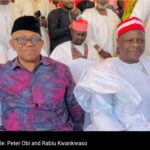
Nigeria’s political landscape ahead of the 2027 presidential election is taking a new shape following the decision of two major opposition figures, Peter Obi and Rabiu Musa Kwankwaso, to put aside their previous presidential ambitions and join forces in an attempt to unseat the incumbent government.
The alliance is particularly significant because both men contested separately in the 2023 presidential election, leading two different political movements and competing for substantially different sections of the Nigerian electorate.

Three years later, however, political calculations appear to have changed.

Kwankwaso has explained that the decision to work with Obi was influenced by what he described as national interest, equity, political balance and the need for democratic change, arguing that opposition forces must work together if they hope to mount a formidable challenge in 2027.
The emerging arrangement places Obi as the presidential candidate of the Nigeria Democratic Congress (NDC), with Kwankwaso as his running mate — bringing together two politicians who previously pursued the presidency independently.
From 2023 Rivals to 2027 Political Partners
In 2023, Obi and Kwankwaso represented two powerful but largely separate political constituencies.
Obi built a nationwide movement heavily supported by younger voters, urban professionals and supporters across the South-East and other parts of the country, while Kwankwaso demonstrated considerable grassroots strength, particularly in Kano and sections of northern Nigeria.
Their separate campaigns prompted arguments at the time that opposition votes were fragmented.
Ahead of 2027, the two politicians appear determined to avoid a repeat of that situation by combining their political structures.
Kwankwaso said he and northern political leaders assessed possible partners and concluded that Obi was the strongest person with whom they could work to pursue their political objectives.
According to him, the decision was therefore not simply about personal ambition but about identifying a candidate around whom different opposition blocs could unite.
Why Kwankwaso Accepted Vice-Presidential Position
One of the biggest questions surrounding the alliance is why Kwankwaso, himself a former presidential candidate and two-term governor of Kano State, agreed to become Obi’s running mate.
Kwankwaso said the decision was influenced by the principle of political balance between northern and southern Nigeria.
According to the former Kano governor, both camps agreed that the presidency should remain in the South for another four years before returning to the North.
He has also confirmed the existence of a written agreement under which Obi would serve one four-year term from 2027 to 2031, if elected, after which the presidency would return to the North.
Kwankwaso said separate agreements were reached involving the party as well as between himself and Obi.
That understanding appears to have removed one of the biggest obstacles that frustrated previous attempts to unite the two political heavyweights: who should be presidential candidate and who should accept the vice-presidential position?
Obi Explains Why He Chose Kwankwaso
Obi has equally explained that his choice of Kwankwaso goes beyond electoral calculations.
The former Anambra State governor said they share similar views about fighting poverty, expanding education and improving economic opportunities.
According to Obi, Kwankwaso’s emphasis on education and lifting people out of poverty aligns with his own development agenda.
Politically, however, the combination could also be designed to unite complementary electoral strengths.
Kwankwaso brings the highly organised Kwankwasiyya grassroots political machinery and substantial northern political experience, while Obi brings the Obidient political movement and the national profile he developed during and after the 2023 election.
The central strategic question is whether those constituencies can be successfully transferred into one unified voting coalition.
Alliance Designed to Challenge Tinubu in 2027
Ultimately, the Obi-Kwankwaso partnership represents an attempt to build an opposition coalition capable of challenging President Bola Ahmed Tinubu and the ruling All Progressives Congress in 2027.
Rather than contest separately and risk splitting opposition votes, the two politicians have chosen to combine their political networks.
Their calculation appears straightforward: Obi’s strength in parts of southern Nigeria and among younger and urban voters, combined with Kwankwaso’s northern grassroots network, could potentially create a broader electoral coalition.
But combining political leaders does not automatically mean their supporters will vote as one bloc.
The alliance will still need to convince voters outside their established strongholds, develop structures across all six geopolitical zones and present a coherent economic, security and governance programme capable of competing with the APC.
Ganduje Dismisses Obi-Kwankwaso Ticket
The alliance is already attracting resistance from the ruling party.
Former APC National Chairman and former Kano State Governor Abdullahi Ganduje has dismissed the Obi-Kwankwaso combination, arguing that the two politicians do not possess the political legacy required to win the 2027 presidential election.
Ganduje particularly questioned whether the ticket could dominate Kano, describing its prospects there in strongly dismissive terms.
Kwankwaso has responded with his own political offensive, arguing that Ganduje, former Kano governor Ibrahim Shekarau and incumbent Governor Abba Yusuf have lost political relevance in Kano.
Those claims remain political assertions that will ultimately be tested by voters.
2027 Battle Could Reshape Nigerian Politics
The Obi-Kwankwaso alliance therefore represents more than the coming together of two former presidential candidates.
It is a strategic attempt to consolidate opposition votes, bridge the North-South political divide and construct a broader electoral coalition capable of challenging the incumbent administration.
For Obi, the partnership provides access to one of northern Nigeria’s most recognisable grassroots political movements.
For Kwankwaso, accepting the vice-presidential ticket provides an opportunity to participate in a potentially stronger national coalition while preserving the possibility of a northern presidential bid after 2031 under their stated agreement.
For President Tinubu and the APC, the challenge will be preventing that opposition arithmetic from translating into a nationwide electoral majority.
As the 2027 campaign approaches, the biggest question will therefore not simply be whether Peter Obi and Rabiu Kwankwaso can work together, but whether they can persuade millions of Nigerians who supported different candidates in 2023 to unite behind one ticket.
That could become one of the defining political battles of the 2027 Nigerian presidential election.


