“Enough Is Enough”: Benue Youths Protest Massacre of Over 200 as Nigeria Grapples with Spiraling Insecurity

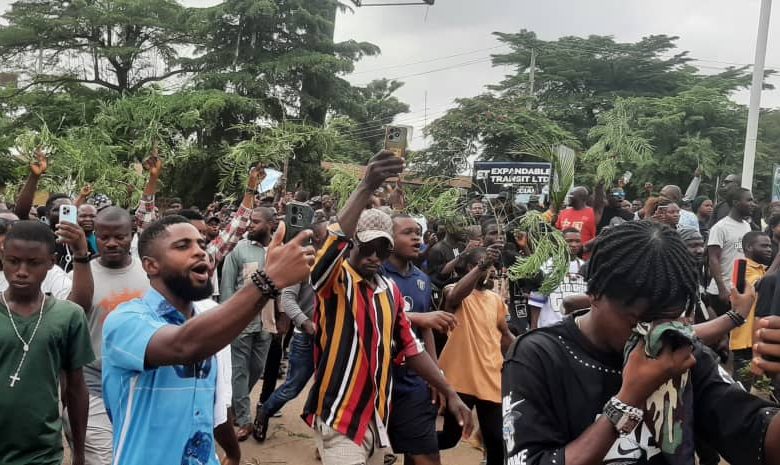

The streets of Makurdi were awash with pain, rage, and defiance on Monday, as thousands of Benue youths took over major roads to protest the latest bloodbath allegedly perpetrated by armed herders in Yelwata, Guma Local Government Area. The carnage, which left more than 200 people dead—including women, children, and internally displaced persons—has once again spotlighted Nigeria’s festering security crisis and the failure of authorities to protect its most vulnerable.
Chanting solidarity songs and waving placards with messages such as “Stop Benue killings” and “Government has failed us,” the demonstrators converged at the Wurukum Roundabout, blocking key routes and resisting attempts by security operatives to disperse them. Helicopters hovered above, tear gas filled the air, but the crowd stood its ground—until one man, social media influencer Martins Otse, better known as VeryDarkMan (VDM), calmed the seething tension.
“I saw children burnt to ashes. A lot of children, a lot of people. We have a government!” Otse declared, urging the youths to adopt peaceful protest strategies and calling on the government to act decisively.
Advertisement
A Massacre and a Movement
Saturday’s attack, described by witnesses as a deliberate and targeted onslaught, came without warning. Survivors recounted the horror: children burnt alive, homes torched, and cries for help that echoed unanswered through the night. Communities in Kadarko and other Tiv settlements near the Nasarawa border have since emptied, as terrified residents fled en masse fearing more bloodshed.

The scale of the atrocity triggered an avalanche of reactions.
President Bola Tinubu, in a statement through his spokesperson Bayo Onanuga, condemned the killings as “inhuman and anti-progress,” and vowed to bring perpetrators to justice. He directed security agencies to act decisively, warning political and community leaders in Benue against inflammatory rhetoric.
“Enough is now enough,” the President said.
However, for many Benue residents, the words rang hollow.
Anger on the Streets
Attempting to address the protesters, Benue Deputy Governor Dr. Sam Ode was met with outright rejection and forced to leave amid chants demanding the presence of Governor Hyacinth Alia. As the police fired tear gas to break up the protest, the demonstrators regrouped, lighting bonfires and barricading roads from Wurukum to the Abu King Shuluwa Junction.
“We cried, we sent letters, but nobody listened to us,” lamented Brahms Ikuan, a protester.
“Today, we are not sure there will be anything called Benue tomorrow.”
Social media activist Seedoff Mbapuunla described the state as “a slaughterhouse,” lamenting the impunity with which lives are taken.
“Yelwata is not far from Makurdi. This could be anyone’s home next,” he said.
National and International Condemnation
From former Vice President Atiku Abubakar to Labour Party’s Peter Obi, voices across Nigeria called the massacre a national emergency. Obi, in a heartfelt post, described the killings as a “failure of leadership and a stain on our collective conscience.”
“We cannot accept the normalization of mass killing. It is intolerable,” Obi said.
Atiku, echoing the urgency, called for transparent investigations and swift justice.
“The time to act is now. We must hold our leaders accountable,” he warned.
The Human Rights Writers Association of Nigeria (HURIWA) went further, demanding the dismissal of Nigeria’s security chiefs for gross incompetence. Its coordinator, Emmanuel Onwubiko, warned that the silence and inaction from the center could ignite ethnic war across the country.
Even Pope Leo XIV raised his voice. In a message delivered during the Sunday Angelus, the Catholic Pontiff prayed for the victims and called for peace and justice in Nigeria’s rural Christian communities—especially in Benue, which he noted had suffered relentless violence.
“Most of the victims were IDPs sheltered by the Catholic mission,” he said.
Amnesty International Nigeria also weighed in, urging the Nigerian government to end the bloodshed and prosecute those responsible.
A State Under Siege
In a statement, Governor Hyacinth Alia, through his Chief Press Secretary, assured the public of strengthened security measures and engagement with federal authorities. But many in Benue remain skeptical.
“How long will we wait? People are killed daily and all we get are statements,” asked Gideon Inyom, a local resident, who also blamed the partial enforcement of the state’s anti-open grazing law for enabling the attackers.
Commissioner of Police Emenari Ifeanyi announced that the Inspector General of Police, Kayode Egbetokun, had taken over Benue’s security. He revealed that special tactical teams had been deployed and were already making progress.
“We have taken over Apa, Gwer West, and are moving seriously in Agatu. The attackers are trying to show control—they are not and will never be,” he stated.
Yet, for villagers like Mathias in Kadarko, it is too little, too late.
“We now sleep in the bush. Women and children are not spared. Is the government with us or against us?” he cried.
The Way Forward
As the dust settles on the streets of Makurdi, the wounds—physical and emotional—remain raw. The protest, though dispersed, was a wake-up call that Benue’s people are tired of being forgotten.
VeryDarkMan’s intervention may have restored momentary calm, but as long as mass killings continue unchecked, the peace will remain precarious.
“A secure Benue is not too much to ask,” said Obi. “It is our moral duty. It is our national duty.”
And the people of Benue are no longer willing to wait in silence.